Assume notifications can arrive out of order. Treat the webhook as a *hint that something changed*, and let the live record be the source of truth.
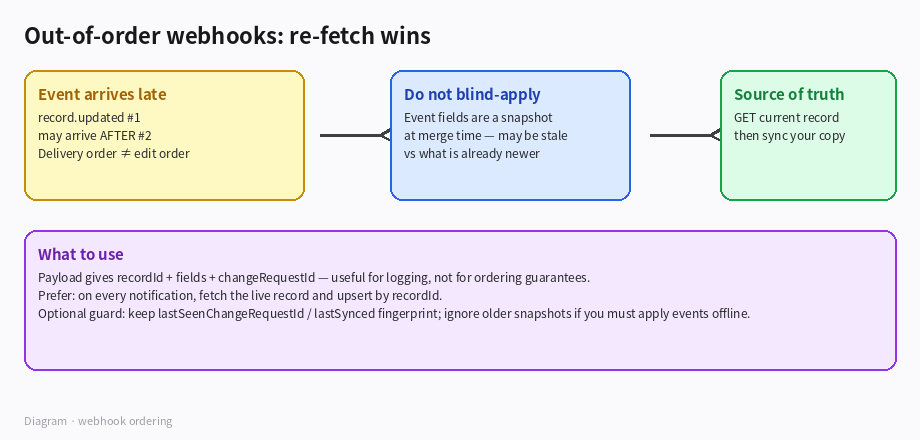
*Diagram · webhook ordering*
What the event gives you
A typical record.updated / record.created body includes roughly:
event — e.g. record.updatedrecordId, baseIdchangeRequestId — which change produced this notificationfields — field snapshot at that merge, not a guarantee it is still the newest thing you will process
Delivery is asynchronous; two quick edits can land at your endpoint in either order.
Recommended receiver pattern
- On every notification, read
recordId (and log changeRequestId for audit). - Fetch the current record from Busabase with your integration key.
- Upsert your copy from that fresh read (not from the event’s
fields alone). - Optional guard if you must apply snapshots offline: store
lastAppliedChangeRequestId / a content fingerprint; skip applying an older snapshot when you already applied a newer one — but still prefer re-fetch when online.
Why not “apply event fields directly”?
The payload’s fields are correct for the change that fired that event. If a newer update already merged (or arrives first), blindly writing the late event can roll your mirror backward.
How to verify
- Update the same record twice within a second; confirm your system ends matching the latest Busabase values regardless of arrival order.
- Temporarily delay processing of the first event; the second-then-first sequence should still converge after re-fetch.
- Use Webhook Test now only for connectivity — then prove ordering with two real edits.
Boundaries
- Do not use wall-clock “time we received the HTTP POST” as the version.
- Signature checks prove authenticity, not ordering.
- If you only need “something changed” triggers (cache bust, queue a job), you can ignore
fields entirely and always re-read.
If you share whether your mirror must stay offline-capable, we can sketch the minimal fingerprint fields to keep.