For a one-off departure from the usual process, record an exception on that request—do not edit the shared process template. That way colleagues see *why this case differed*, *who approved it*, and *which request it applies to*, without treating it as a permanent rule change.
Recommended model in Busabase
| Base | Fields | Notes |
|---|
| Process template (unchanged) | Standard steps | Rulebook for everyone; leave alone for one-offs |
| Requests | Normal request fields | The case being handled |
| Exception log | Relation → Request | One (or more) exception rows per request |
| reason (Long text) | Why the usual step was skipped / altered |
| skippedStep (Text or Select) | Which step in the template |
| approver (Person / Text / Relation) | Who agreed |
| approvedAt (Date / DateTime) | When |
| scope Select | e.g. this_request / This request only |
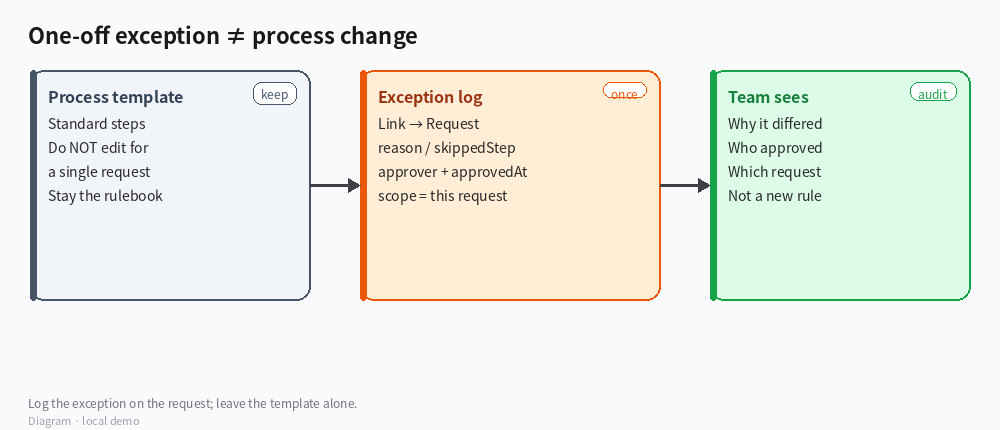
*Diagram · exception log linked to the request; template stays intact*
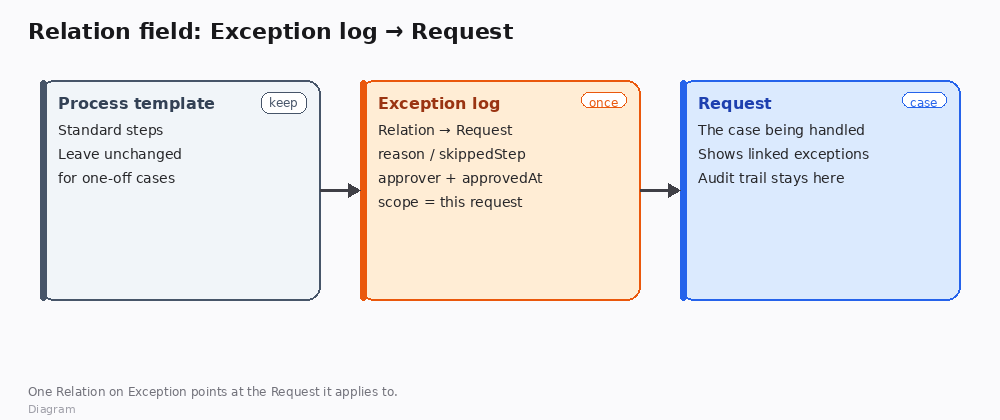
*Diagram · Relation field links Exception → Request*
How to work day to day
- Handle the request under the normal process whenever you can.
- When you must skip or alter a step, add an Exception log row linked to that Request—fill reason, skipped step, approver, approvedAt, scope=
this_request. - Optionally add a short comment on the Request: “See exception log.”
- Do not remove or rewrite steps on the Process template for this single case.
How to verify
- Open the Request: the exception row is visible with reason + approver.
- Open the Process template: steps are unchanged.
- A colleague reading only the template still sees the standard rule; reading the Request sees the documented exception.
Boundaries
- Repeated exceptions of the same kind → discuss a real process update (separate change), not silent template edits.
- Emergency verbal approvals: still create the log row as soon as practical so the audit trail exists.
- Scope should stay “this request”; if someone needs a standing waiver, that’s a different object (policy exception), not a one-line skip.
If you share whether approvals are a Person field or a free-text name, we can tighten the field list to match your workspace.